
Why Skincare Products Need Preservatives
Any product that contains water is at risk of microbial contamination. Bacteria, mold, and yeast multiply rapidly in moist environments. Without preservation, a cream could become unsafe within days of opening. The goal is to extend safe shelf life -- where brands diverge is in how they do it.
This isn't optional for water-based products, and it isn't a marketing choice either -- it's basic microbiology. What actually varies from brand to brand is the formulation strategy: some rely on a broad-spectrum synthetic preservative system tested against a wide microbial challenge; others, like Luna Fresh, sidestep the problem at the formula level by avoiding water in the first place. Both are legitimate approaches to the same underlying requirement -- what matters is which trade-offs a brand is transparent about.
Why This Matters for Sensitive Skin
Certain synthetic preservatives are known sensitizers -- repeated exposure can trigger allergic reactions or chronic inflammation, especially in people with eczema, rosacea, or reactive skin.
The Most Common Synthetic Preservatives to Know
1. Parabens (methylparaben, propylparaben, butylparaben)
For decades, parabens were the industry standard. They are cheap and effective. However, research has identified parabens as endocrine disruptors -- substances that mimic estrogen and may interfere with hormonal function. The EU has banned the longer-chain parabens in cosmetics, and parabens, along with formaldehyde-releasing preservatives, appear on Health Canada's Cosmetic Ingredient Hotlist of prohibited and restricted substances.
2. Phenoxyethanol
Often marketed as a "natural" alternative to parabens, phenoxyethanol is a synthetic ether alcohol. It can cause contact dermatitis in sensitive individuals. In 2008, the FDA warned against a nursing nipple cream that combined phenoxyethanol with chlorphenesin, after finding the pairing could depress an infant's central nervous system if ingested during breastfeeding — a reminder that a preservative's safety profile can change depending on where on the body a product is applied, not just its concentration.
3. Formaldehyde-Releasing Preservatives
DMDM Hydantoin, Imidazolidinyl Urea, and Quaternium-15 work by slowly releasing formaldehyde, which the International Agency for Research on Cancer (IARC) classifies as a Group 1 carcinogen — its highest-confidence category, based on sufficient evidence in humans. Formaldehyde is also a common sensitizer, particularly problematic for people with fragrance or chemical sensitivities.
How to Spot Them on Labels
Look for: DMDM Hydantoin, Diazolidinyl Urea, Imidazolidinyl Urea, Quaternium-15, BHMT, Bromopol. These indicate formaldehyde-releasing preservation systems.
Natural Preservation Strategies
Natural preservation does not mean unpreserved. At Luna Fresh, we use a combination of strategies that work without synthetic chemicals:
Luna Fresh 5-Point Preservation Approach
- Anhydrous (water-free) formulas: Most of our products are oil-based. Without water, microbial growth is dramatically slowed -- eliminating the need for traditional preservatives.
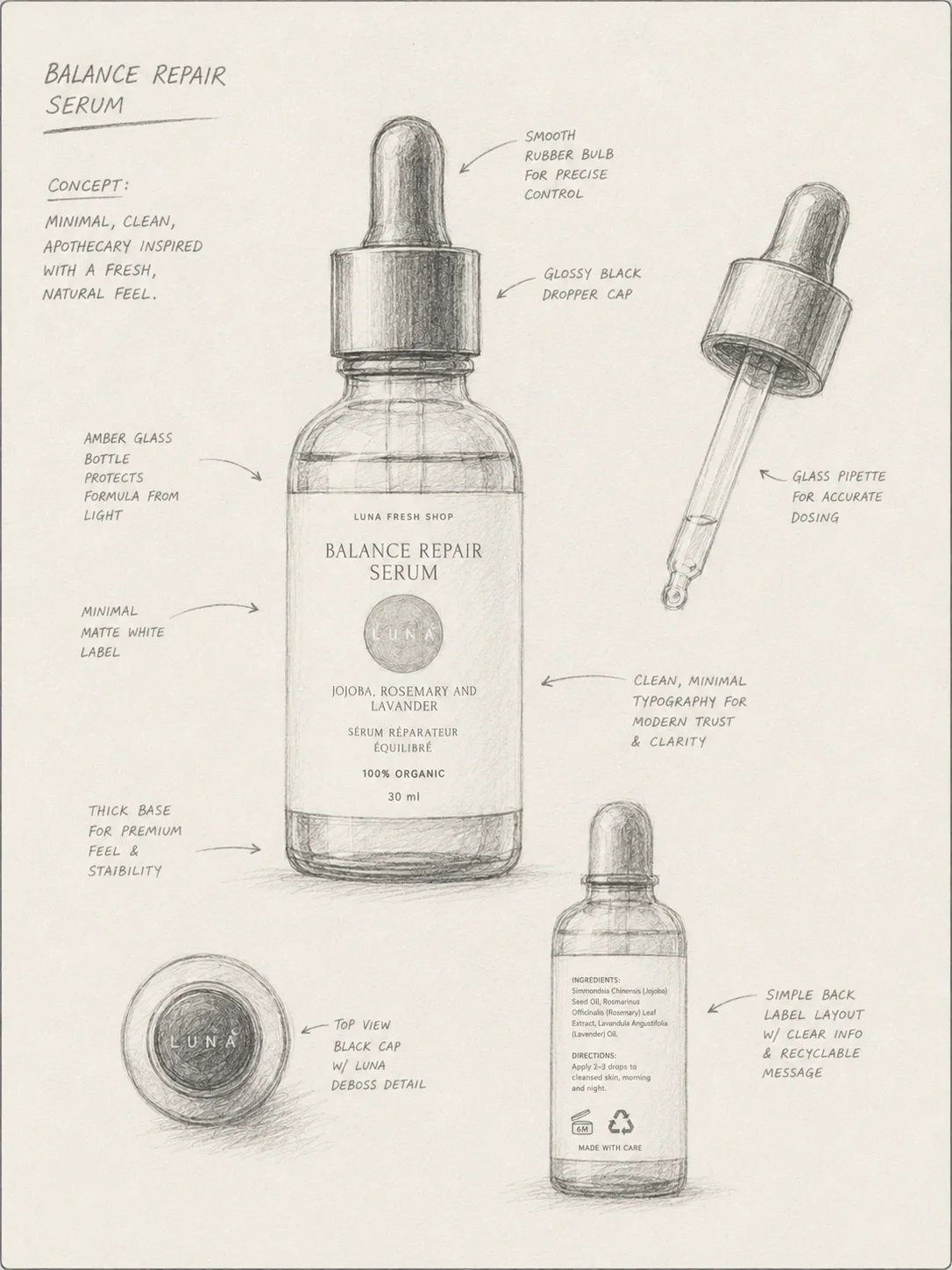
- Amber glass packaging: UV-filtering glass protects botanical actives from photo-oxidation without additives.
- Vitamin E (Tocopherol): A natural antioxidant that prevents oils from going rancid by neutralizing free radicals.
- Rosemary Leaf Extract (ROE): A powerful natural antioxidant for oil-based formulas, extracted without solvents.
- Small-batch production: By producing in small quantities and dating every batch, you receive a product at peak freshness.
An Important Nuance: Anhydrous Isn't a Free Pass
It's tempting to hear "no water, no preservative" and assume that's automatically the safer option -- but it's worth being precise about what that actually protects against. Anhydrous formulas are much more resistant to bacterial and fungal growth, since most microbes need water to reproduce. What they're not automatically protected from is oxidation, which is a chemical process, not a microbial one -- that's a separate problem, and it's why amber glass, vitamin E, and rosemary extract each do a specific job in the formula rather than being redundant. A truly unpreserved, undated product of any kind -- natural or synthetic -- is the actual risk to watch for, not any single ingredient by itself.
What to Look for on the Label
- Any -paraben suffix -- paraben family. Common in conventional mass-market skincare.
- Phenoxyethanol -- widely used synthetic, often paired with ethylhexylglycerin.
- DMDM Hydantoin or Urea compounds -- formaldehyde-releasing agents.
- Short ingredient lists with recognizable plant names -- typically a sign of a cleaner formula.
Frequently Asked Questions
Are all synthetic preservatives unsafe?
No -- most are approved because they pass safety testing at the concentrations used in cosmetics. The concern for sensitive skin is less about acute danger and more about cumulative sensitization from repeated daily exposure, which is a different question than whether a single use is "toxic."
Why doesn't Luna Fresh use any preservative at all?
We do -- just not synthetic ones. Vitamin E and rosemary extract are functioning preservative-adjacent antioxidants, and going anhydrous (water-free) removes the specific risk that most cosmetic preservatives exist to control in the first place. "Natural" doesn't mean "unpreserved" -- see the section above.
How can I tell if a product has gone bad?
For oil-based products, trust your nose before the calendar -- a sharp, sour, or "crayon-like" smell replacing the usual botanical scent means it's time to replace it, even if it's before the batch date on the label would suggest.
Skincare You Can Actually Read
Every Luna Fresh product lists every ingredient -- no hidden chemicals, no synthetic preservatives, no exceptions.
Shop Synthetic-Free SkincareAbout the Author: Luna Fresh
Iris & Mireya are the Co-Founders and Formulators behind Luna Fresh. Driven by family heritage and a mother's journey with sensitive skin, they combine South American botanical traditions to create skincare that is 100% honest, transparent, and synthetic-free.