
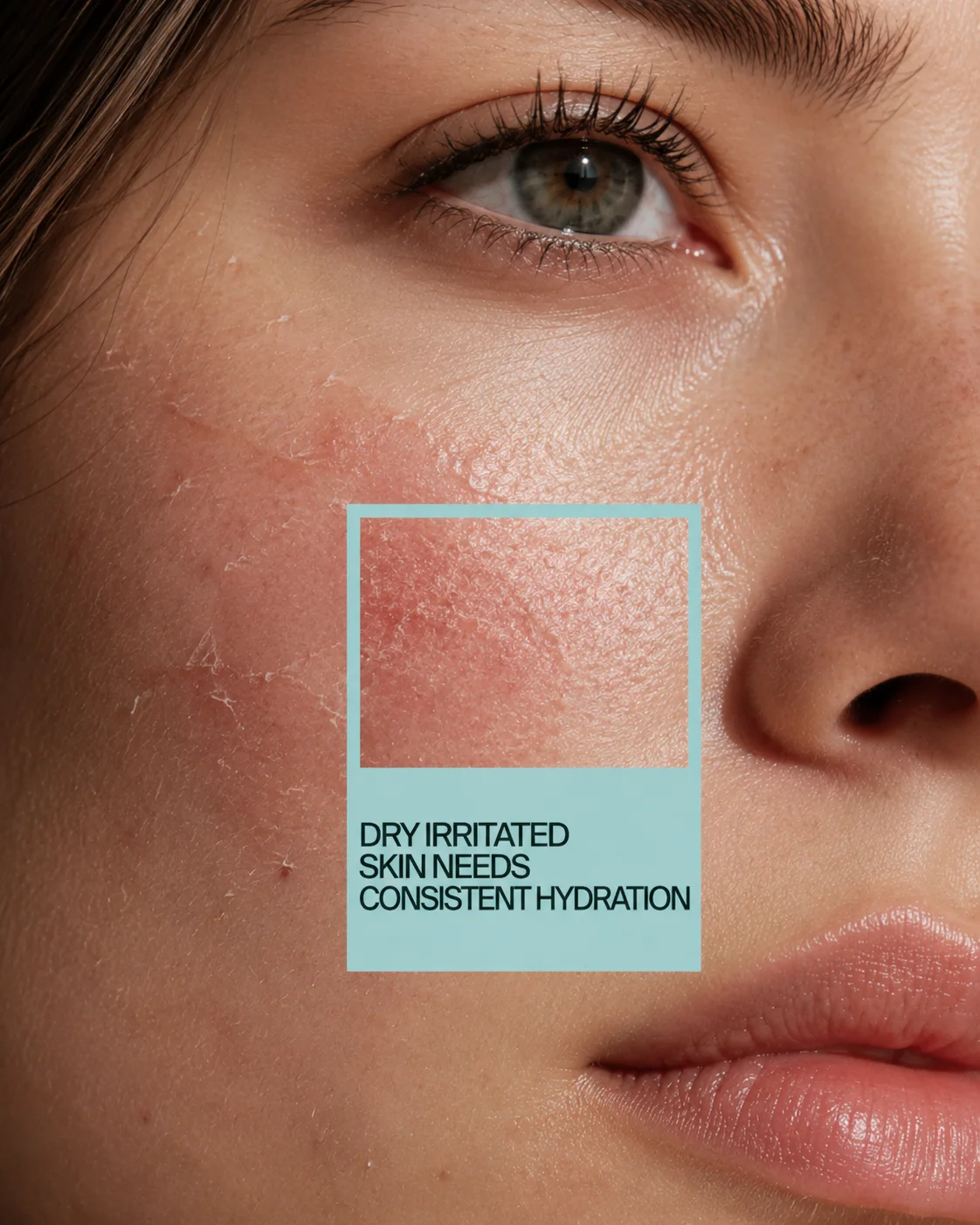
Understanding the Sensitive Skin Barrier
Sensitive skin isn't a "flaw" to be fixed — it's a sign of a delicate or compromised stratum corneum (the outermost protective layer of your skin). Research on the stratum corneum barrier shows that when this layer loses moisture or comes into contact with harsh synthetic agents, inflammation triggers quickly.
The stratum corneum works like a brick wall: skin cells are the "bricks," and lipids — ceramides, cholesterol, and fatty acids — are the "mortar" holding everything together. When that mortar breaks down (from harsh surfactants, over-cleansing, or dry winter air), water escapes faster than it should. Dermatologists call this trans-epidermal water loss, or TEWL. Higher TEWL means a thinner defense against irritants, which is exactly why sensitive skin reacts to products that wouldn't bother anyone else.
Conventional skincare often tries to solve sensitivity by adding more reactive active ingredients, acids, or heavy artificial masking fragrances. But true healing starts with simplification: eliminating triggers and nourishing the skin with ancestral botanicals that mirror natural skin lipids.
The Wabi-Sabi Philosophy of Healing
At Luna Fresh, we embrace wabi-sabi — the beauty of natural imperfection. Real skin moves through cycles, seasons, and stress. True care doesn't mean harsh chemical resurfacing; it means offering gentle, living ingredients made by hand in small batches.
What Actually Triggers Reactive Skin in Calgary?
Sensitivity isn't only about what's in the bottle — climate plays a real role, and Calgary's is a tough one for skin barriers. Chinook winds can swing the temperature more than 15°C in a single day, and our winter humidity regularly drops into single digits indoors once the furnace kicks in. Both stress the same lipid "mortar" described above, which is part of why so many Calgarians describe their skin as fine all summer and reactive by November.
A few other common triggers worth ruling out before blaming a new product:
- Hot water: Water above roughly 38°C strips protective oils faster than lukewarm water, especially on the face.
- Over-exfoliating: Daily acids or scrubs on already-reactive skin keep the barrier from ever fully rebuilding.
- Layering too many actives at once: Retinoids, vitamin C, and exfoliating acids used together can compound irritation even if each is fine alone.
- Hard water: Calgary's municipal water is moderately hard; mineral residue left on skin after rinsing can contribute to tightness in already-dry skin.
Red-Flag Ingredients to Avoid
When shopping for reactive or eczema-prone skin, turn the bottle over and read every ingredient like an open book. If you spot any of the following, put it back:
Ingredients to Avoid for Sensitive Skin
- Synthetic Fragrance ("Parfum"): Fragrance is the leading cause of allergic contact dermatitis from cosmetics, ahead of preservatives and hair dyes, according to a peer-reviewed review in Actas Dermo-Sifiliográficas. The word "parfum" or "fragrance" on a label can legally hide dozens of unlisted individual compounds, so there's no way to know which one is the trigger.
- Sulfates (SLS / SLES): Harsh detergents that strip essential moisture and break down lipid bonds — the same "mortar" that keeps TEWL in check.
- Synthetic Preservatives (Parabens / Phenoxyethanol): High concentrations irritate compromised skin barriers, though small-batch products still need some form of preservation — see our preservatives article for how we handle that trade-off.
- Drying Alcohols (Alcohol Denat / Isopropyl): Evaporate skin surface moisture rapidly, causing reactive tightness — different from the fatty alcohols (like cetyl or stearyl alcohol) that are actually moisturizing and safe.
Nourishing Botanical Allies
Instead of synthetic fillers, look for cold-pressed, unrefined organic plant oils that restore your moisture barrier without clogging pores:
- Jojoba Oil: Technically a liquid wax, not a true oil — structurally close to human sebum, which lets it absorb quickly and help regulate the skin's own oil production instead of just sitting on the surface.
- Organic Rosemary Extract: Rich in antioxidants (notably rosmarinic acid) that help calm oxidative stress and soothe red, irritated patches; also acts as a natural stabilizer that helps protect the oils around it from going rancid.
- Lavender Oil (Distilled): Traditionally used for its calming, anti-inflammatory properties that ease tightness and support the skin's natural recovery — always diluted into a carrier oil before it touches skin.
- Aloe Vera Juice: Mostly water by weight, which is exactly why it hydrates the deeper epidermis without leaving a greasy residue behind.
- German Chamomile: Contains bisabolol, a compound studied for its soothing effect on visibly irritated or reactive skin — the reason it's the base of our Chamomile Cream.
What to Look For Instead
- 100% Organic, Cold-Pressed Botanical Base Oils
- Small-Batch Handmade Freshness (No Stale Oils)
- UV-Protective Amber Glass Packaging
- Full Ingredient Transparency on the Label
Building Your Minimal 3-Step Routine
When your skin is reactive, less is more. Stick to three essential steps morning and evening:
1. Gentle Rinse: Cleanse with tepid (not hot) water or a mild sulfate-free botanical cleanser. In Calgary's dry winter months, some people find their skin does better skipping the AM cleanse entirely and just rinsing with water.
2. Hydrate & Prep: Mist lightly with pure rosewater toner to balance pH — apply to slightly damp skin so the mist has something to lock in.
3. Lock Moisture: Massage 3–4 drops of Balance Repair Serum onto damp skin while it's still slightly wet from the toner; this traps more moisture than applying oil to fully dry skin.
Introduce any new product one at a time, with at least a week between additions. If your routine already has more than three products and your skin still isn't calm, that's usually a sign to simplify further, not add another "solution" on top.
How to Patch-Test Properly
Patch-testing catches most reactions before they reach your face — but only if it's done for long enough. A quick sniff or a five-minute wrist swipe isn't a real test:
- Apply a small amount to the inside of your forearm, an area with thinner skin than your hands but sturdier than your face.
- Leave it undisturbed — no washing that spot — for 24 to 48 hours.
- Watch for redness, itching, bumps, or burning, not just at the first hour but again the next day; some reactions are delayed.
- If it's clear after 48 hours, it's reasonable to try a small area on the jawline before full-face use.
Frequently Asked Questions
How long does it take for sensitive skin to calm down after switching products?
Most people notice less reactivity within 2 to 4 weeks of removing the main triggers (fragrance, sulfates, harsh alcohols), since that's roughly how long the outer skin barrier takes to turn over and rebuild.
Can sensitive skin use active ingredients like vitamin C or retinol?
Often yes, but one at a time, in a low concentration, and only once the barrier is calm — introducing actives during a flare-up tends to make things worse, not better.
Is "fragrance-free" the same as "unscented"?
No. "Unscented" products can still contain masking fragrance to cover a raw ingredient smell. "Fragrance-free" means no fragrance compounds were added at all — that's the label to look for.
Handmade for Sensitive Skin in Calgary
Every Luna Fresh formula is 100% synthetic-free, handmade in small batches, and packaged in protective amber glass.
Explore Our Skincare CollectionAbout the Author: Luna Fresh
Iris & Mireya are the Co-Founders and Formulators behind Luna Fresh. Driven by family heritage and a mother's journey with sensitive skin, they combine South American botanical traditions with small-batch craftsmanship to create skincare that is 100% honest, transparent, and synthetic-free.